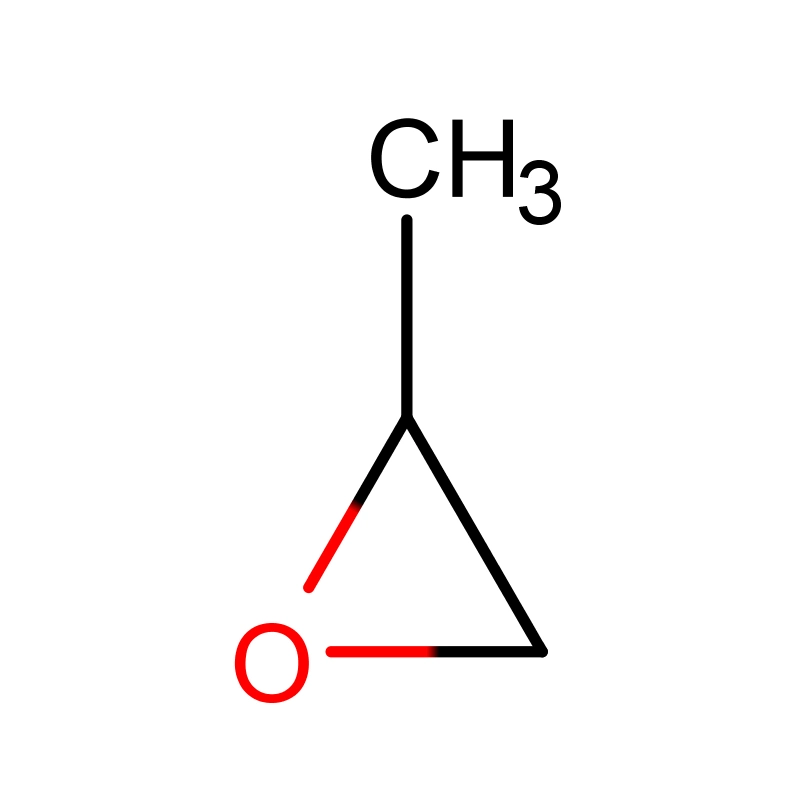
Products Description of Propylene Oxide CAS#75-56-9
Propylene oxide (PO), alternatively named 1,2-propylene oxide or methyloxirane (methyl ethylene oxide), is a colourless, flammable, volatile liquid carrying an ether-like smell. Its molecular weight is 58.08, with a relative density of 0.83 measured at 25°C.
It is miscible with most conventional organic solvents. It creates a binary azeotrope containing 1% water with an azeotropic temperature of 39.9°C. Additionally, PO is able to form azeotropic mixtures with dichloromethane, diethyl ether, cyclohexane, cyclopentane, pentene and other solvents.
Propylene Oxide Chemical Properties
| Melting point | -112 °C |
| Boiling point | 34 °C(lit.) |
| density | 0.83 g/mL at 25 °C(lit.) |
| vapor density | 2 (vs air) |
| vapor pressure | 29.43 psi ( 55 °C) |
| refractive index | n20/D 1.366(lit.) |
| Fp | −35 °F |
| storage temp. | 2-8°C |
| solubility | 425-450g/l |
| form | Liquid |
| color | Clear |
| Odor | Ethereal; characteristic; sweet, alcoholyc; like natural gas. |
| explosive limit | 1.9-36%(V) |
| Water Solubility | 40 g/100 mL (20 ºC) |
| FreezingPoint | -112.13℃ |
| Merck | 147856 |
| BRN | 79763 |
| Henry's Law Constant | Not an environmentally important parameter because propylene oxide reacts rapidly with water |
| Exposure limits | TLV-TWA 50 mg/m3 (20 ppm) (ACGIH), 240 mg/m3 (100 ppm) (OSHA); IDLH 2000 ppm. |
| Stability: | Stable. Incompatible with acids, bases, oxidizing agents, copper, copper alloys, brass, bronze, iron, metal chlorides, peroxides and a wide variety of other materials. Reacts with compounds containing labile hydrogen. Extremely flammable - note low boiling point, low flash point and very wide explosion limits. Moisture sensitive. |
| LogP | 0.03 |
| CAS DataBase Reference | 75-56-9(CAS DataBase Reference) |
| NIST Chemistry Reference | Propylene oxide(75-56-9) |
| IARC | 2B (Vol. Sup 7, 60) 1994 |
| EPA Substance Registry System | Propylene oxide (75-56-9) |
Safety Information
| Hazard Codes | F+,T |
| Risk Statements | 45-46-12-20/21/22-36/37/38 |
| Safety Statements | 53-45 |
| RIDADR | UN 1280 3/PG 1 |
| WGK Germany | 3 |
| RTECS | TZ2975000 |
| Autoignition Temperature | 430 °C |
| TSCA | Yes |
| HS Code | 2910 20 00 |
| HazardClass | 3 |
| PackingGroup | I |
| Hazardous Substances Data | 75-56-9(Hazardous Substances Data) |
| Toxicity | LD50 orally in rats: 1.14 g/kg (Smyth) |
| IDLA | 400 ppm |
Product Application of Propylene Oxide CAS#75-56-9
Propylene oxide is a fundamental epoxide intermediate widely deployed in the fine chemical and petrochemical sectors. Its largest consumption is for producing polyether polyols, which are key feedstock for flexible and rigid polyurethane foams, elastomers, coatings, adhesives and sealants used in construction, automotive and home appliance industries. It is also hydrolyzed to manufacture propylene glycol and dipropylene glycol, applied in unsaturated polyester resins, antifreeze agents, cosmetics and pharmaceutical excipients.
Additionally, it reacts to form nonionic surfactants, oil demulsifiers and pesticide emulsifiers for oilfield, textile and agrochemical fields. It can act as a low-boiling solvent for special resin systems and a fumigant for disinfection of spices, nuts and cocoa. It is also used to synthesize isopropanolamines, propylene carbonate and other specialty chemical derivatives.