

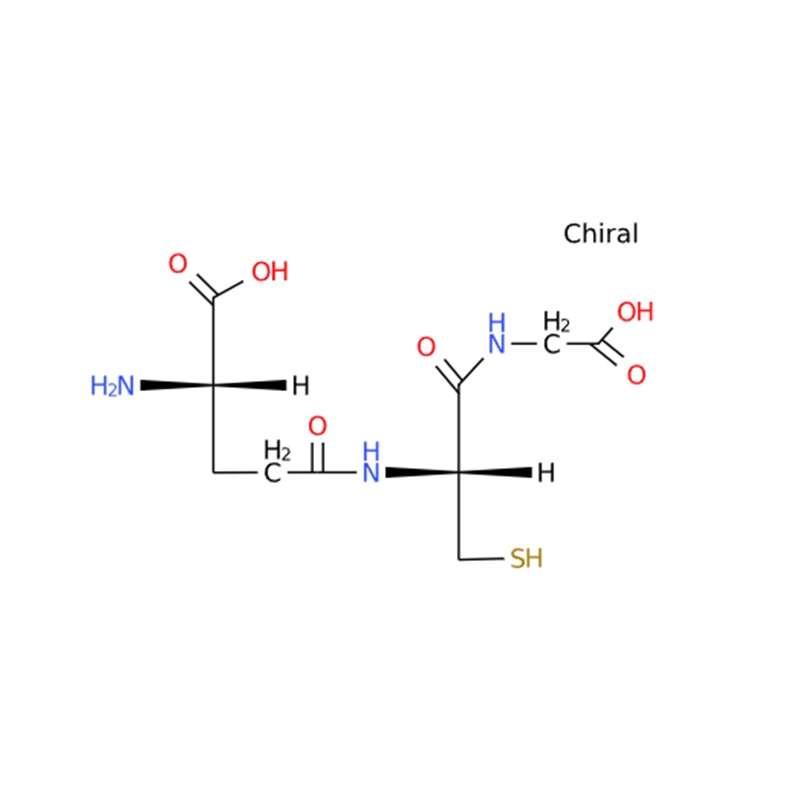
Products Description of Glutathione CAS#70-18-8
Glutathione belongs to the class of tripeptides, synthesized when glutamic acid, cysteine and glycine undergo condensation reactions to form peptide bonds. As a pivotal low-molecular-weight thiol substance, it safeguards mammalian cells from oxidative stress damage. This substance was first isolated in 1921, and its chemical structure was clarified in 1930. Dr. Al Mindell, a distinguished American specialist in nutrition and healthcare, defined glutathione as a triple-action anti-ageing amino acid, earning it the well-known title “the master antioxidant in nature”.
Physically, glutathione exists as colourless, transparent, elongated crystalline granules. It dissolves readily in water, dilute alcohol, liquid ammonia and dimethylformamide, yet cannot dissolve in ethanol, ether or acetone. While solid glutathione boasts decent stability, its aqueous solution tends to be oxidised into oxidised glutathione upon exposure to air.
Glutathione naturally occurs abundantly in baker’s yeast, wheat germ, animal livers, chicken blood, pig blood, tomatoes, pineapples and cucumbers. Wheat germ and animal livers contain the highest concentrations, ranging from 100 to 1000 mg per 100 grams. It possesses diverse biological properties: it acts as an antioxidant and free radical scavenger, delivers detoxifying effects, boosts immunity, delays ageing, exerts anti-tumour functions and shields organisms from radiation injury. Furthermore, it promotes the bactericidal capacity of white blood cells, inhibits the oxidation of vitamin C and vitamin E, and lowers the risks of stroke and cataract development. Apart from that, glutathione is capable of combining with carcinogens and accelerating their elimination from the human body via urinary excretion.
Glutathione Chemical Properties
Melting point | 192-195 °C (dec.) (lit.) |
alpha | -16.5 º (c=2, H2O) |
Boiling point | 754.5±60.0 °C(Predicted) |
density | 1.4482 (rough estimate) |
refractive index | -17 ° (C=2, H2O) |
storage temp. | 2-8°C |
solubility | H2O: 50 mg/mL |
form | powder |
pka | pK1 2.12; pK2 3.53; pK3 8.66; pK4 9.12(at 25℃) |
color | White |
PH | 3 (10g/l, H2O, 20°C) |
Odor | Odorless |
Water Solubility | soluble |
Merck | 144475 |
BRN | 1729812 |
Sequence | H-γ-Glu-Cys-Gly-OH |
Stability: | Stable. Incompatible with strong oxidizing agents. |
InChIKey | RWSXRVCMGQZWBV-WDSKDSINSA-N |
LogP | -1.645 (est) |
CAS DataBase Reference | 70-18-8(CAS DataBase Reference) |
EPA Substance Registry System | Glutathione (70-18-8) |
Hazard Codes | Xi |
Risk Statements | 68-36/37/38 |
Safety Statements | 24/25-36/37/39-27-26 |
WGK Germany | 2 |
RTECS | MC0556000 |
F | 46288 |
TSCA | Yes |
HS Code | 29309070 |

Product Application of Glutathione CAS#70-18-8
Glutathione is an antioxidant produced inside organisms. It functions crucially in eliminating reactive oxygen species produced in cellular metabolism and respiratory bursts. The enzyme glutathione-S-transferase facilitates the synthesis of glutathione thioethers by reacting glutathione with xenobiotics, leukotrienes and other electrophilic substances. Besides, glutathione is able to form disulfide linkages with cysteine residues on proteins. Via these biochemical pathways, glutathione may affect the therapeutic efficacy of some anti-cancer drugs.