
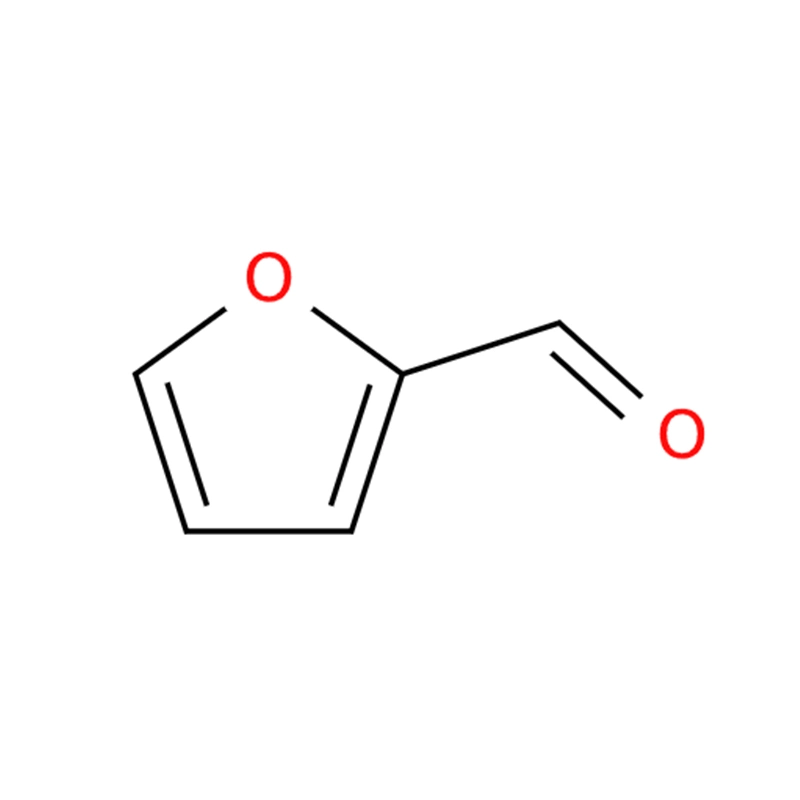
Product Description of Furfural CAS#98-01-1
Made-available by hydrolyzing and dehydrating pentosan from plant-based fibre feedstock, furfural is a transparent oily liquid ranging from colourless to pale yellow. This substance is alternatively named furan-2-carbaldehyde or 2-furaldehyde and carries a distinctive aromatic scent.Its hue will shift from yellow-brown towards deep-brown once it gets subjected to illumination, high-temperature surroundings, airborne oxidation or mineral acids. Polymerisation may then take place to generate resin-like deposits. For proper preservation, the chemical needs air-tight packaging with oxygen-free storage environments and light-shielded treatment.
It mixes incompletely with water and dissolves well inside ethanol, ether as well as acetic acid. Furfural boasts outstanding dissolving capacity for aromatic hydrocarbons, alkenes, polar chemicals and some high-molecular-mass materials, yet it barely dissolves saturated substances like alkane hydrocarbons and long-chain fatty acids.
Thanks to its reactive aldehyde functional-group and furan-ring framework, the compound is capable of multiple chemical transformations such as oxidation, hydrogenation, nitration, decarbonylation and condensation to yield plenty of high-value derivatives. Its chemical traits resemble benzaldehyde and it can participate in Benzoin, Perkin and Cannizzaro-type reactions.
In qualitative testing, its reaction with aniline within glacial acetic acid yields vivid-red products for easy recognition. Chromatographic testing, titration techniques (hydroxylamine-hydrochloride and tetrabromide approaches) and gravimetric assays with phloroglucinol or barbituric acid serve for quantitative inspection. The hydroxylamine-hydrochloride test remains the mainstream detection technique for finished goods within domestic industry.
Furfural Chemical Properties
| Melting point | -36 °C (lit.) |
| Boiling point | 162 °C (lit.) |
| density | 1.16 g/mL at 25 °C (lit.) |
| vapor density | 3.31 (vs air) |
| vapor pressure | 13.5 mm Hg ( 55 °C) |
| refractive index | n20/D 1.527 |
| FEMA | 2489 | FURFURAL |
| Fp | 137 °F |
| storage temp. | Store below +30°C. |
| solubility | 95% ethanol: soluble1ML/mL, clear |
| form | Liquid |
| color | Colorless to pale yellow (amber) |
| Odor | at 1.00 % in dipropylene glycol. sweet woody almond fragrant baked bread |
| PH | >=3.0 (50g/l, 25℃) |
| explosive limit | 2.1-19.3%(V) |
| Odor Type | bready |
| Water Solubility | 8.3 g/100 mL |
| FreezingPoint | -36.5℃ |
| Sensitive | Air Sensitive |
| Merck | 144304 |
| JECFA Number | 450 |
| BRN | 105755 |
| Henry's Law Constant | 1.52(x 10-6 atm?m3/mol) at 20 °C (approximate - calculated from water solubility and vapor pressure) |
| Exposure limits | NIOSH REL: IDLH 100 ppm; OSHA PEL: TWA 5 ppm (20 mg/m3); ACGIH TLV: TWA 2 ppm (adopted). |
| Dielectric constant | 41.9(20℃) |
| Stability: | Stable. Substances to be avoided include strong bases, strong oxidizing agents and strong acids. Flammable. |
| LogP | 0.41 |
| CAS DataBase Reference | 98-01-1(CAS DataBase Reference) |
| IARC | 3 (Vol. 63) 1995 |
| NIST Chemistry Reference | 2-Furancarboxaldehyde(98-01-1) |
| EPA Substance Registry System | Furfural (98-01-1) |
Safety Information
| Hazard Codes | T,Xi |
| Risk Statements | 21-23/25-36/37-40-36/37/38 |
| Safety Statements | 26-36/37/39-45-1/2-36/37 |
| RIDADR | UN 1199 6.1/PG 2 |
| WGK Germany | 2 |
| RTECS | LT7000000 |
| F | 37113 |
| Autoignition Temperature | 599 °F &_& 599 °F |
| Hazard Note | Irritant |
| TSCA | Yes |
| HS Code | 2932 12 00 |
| HazardClass | 6.1 |
| PackingGroup | II |
| Hazardous Substances Data | 98-01-1(Hazardous Substances Data) |
| Toxicity | LD50 orally in rats: 127 mg/kg (Jenner) |
| IDLA | 100 ppm |
Product Application of Furfural CAS#98-01-1
As a vital building-block chemical, furfural supports the fabrication of diverse industrial supplies and medicinal substances. It works as the starting material to prepare many chemicals such as succinaldehyde, furan-acrylic acid, furfurylamine, fumaric acid, adipic acid and furfuryl alcohol.
Multiple substances derived from furfural possess powerful germ-killing capacity and wide-ranging antibacterial performance. One representative case is furazolidone, a sanitizing and antiseptic agent manufactured from furfural via multi-step synthetic procedures.
This raw material participates heavily in fine-chemical manufacturing covering medicine, agrochemicals, animal-care reagents, colourants, aroma substances, rubber modifiers and antiseptics. It also creates synthetic resin varieties including furan, furfural and furfuryl-alcohol resin. With outstanding tolerance against high temperature, moisture and alkaline substances, these resins fit anti-corrosion inner coatings, resin-based mortar and bonding materials.
Besides, furfural acts as a selective solvent for crude-oil refinement and edible-oil treatment. It separates unsaturated and aromatic ingredients out of lubricant and diesel to upgrade finished-oil quality. The synthetic-rubber sector applies it for isolating and purifying butadiene along with isoprene.
Operators need standard operating practices during manipulation because the substance is capable of irritating human skin and mucosal tissue.