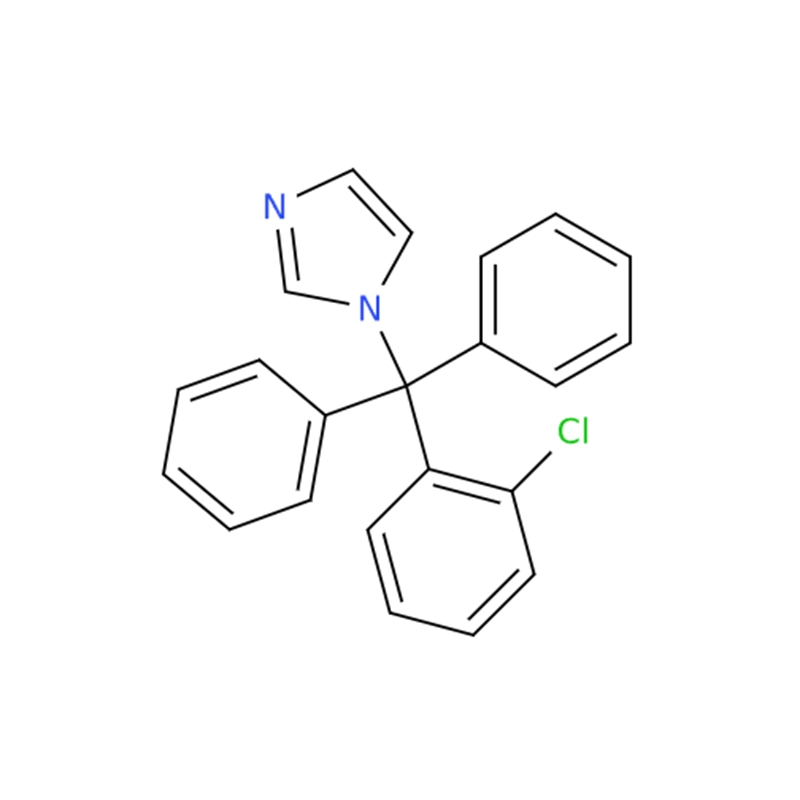
Products Description of Clotrimazole CAS#23593-75-1
Clotrimazole is a synthetic azole antifungal agent with potent inhibitory activity against a wide spectrum of pathogenic fungi, and displays fungicidal effects at elevated concentrations. Its pharmacological mechanism is mainly based on the inhibition of fungal cytochrome P450 activity, which blocks the biosynthesis of ergosterol and other essential fungal sterols.
By inhibiting ergosterol synthesis, clotrimazole impairs fungal cell membrane structure and increases membrane permeability, resulting in the leakage of intracellular substances and damage to fungal cell viability. Meanwhile, it suppresses the synthesis of fungal triglycerides and phospholipids, further interfering with fungal growth and metabolic functions.
In addition, clotrimazole inhibits fungal oxidase and peroxidase activities, causing excessive accumulation of peroxides inside fungal cells and ultimately leading to subcellular structural degeneration and fungal necrosis.
With excellent broad-spectrum antifungal performance, clotrimazole is highly effective against Epidermophyton, Trichophyton, Aspergillus, dematiaceous fungi, Cryptococcus and Candida. It also presents definite inhibitory effects against Sporothrix schenckii, Blastomyces dermatitidis, Coccidioides immitis, Histoplasma and other pathogenic fungi.
Clotrimazole Chemical Properties
| Melting point | 147-149°C |
| Boiling point | 501.14°C (rough estimate) |
| density | 1.1095 (rough estimate) |
| refractive index | 1.5940 (estimate) |
| storage temp. | 2-8°C |
| solubility | Soluble in chloroform, DMSO, DMF and alcohols |
| pka | pKa 4.7(EtOH 50%aq ) (Uncertain) |
| color | White to Almost white |
| Water Solubility | <10mg/L(25 ºC) |
| λmax | 556nm(Phosphate buffer sol.)(lit.) |
| Merck | 142417 |
| InChI | InChI=1S/C22H17ClN2/c23-21-14-8-7-13-20(21)22(25-16-15-24-17-25,18-9-3-1-4-10-18)19-11-5-2-6-12-19/h1-17H |
| InChIKey | VNFPBHJOKIVQEB-UHFFFAOYSA-N |
| SMILES | C1N(C(C2=CC=CC=C2Cl)(C2=CC=CC=C2)C2=CC=CC=C2)C=CN=1 |
| NIST Chemistry Reference | Clotrimazole(23593-75-1) |
| Hazard Codes | Xn |
| Risk Statements | 22-36/38 |
| Safety Statements | 26-36 |
| WGK Germany | 3 |
| RTECS | NI4377000 |
| HS Code | 29332900 |
| Hazardous Substances Data | 23593-75-1(Hazardous Substances Data) |
| Toxicity | LD50 in male mice, rats (mg/kg): 923, 708 orally (Tettenborn) |

Product Application of Clotrimazole CAS#23593-75-1
Clotrimazole is a broad-spectrum antifungal agent widely used in clinical treatment. In topical formulations, 1% clotrimazole cream or solution is indicated for various superficial cutaneous fungal infections, including cutaneous candidiasis, tinea versicolor, tinea pedis and onychomycosis. Clotrimazole vaginal tablets (100 mg) are applied to treat vaginal infections caused by Candida and Trichomonas, with possible local adverse reactions such as irritation and burning sensation. Oral dosage forms are suitable for deep fungal infections but may cause obvious side effects, including gastrointestinal irritation, neutropenia and abnormal liver function.
1. Oral Administration
(1) Treatment of oropharyngeal candidiasis. (2) Prevention of oropharyngeal candidiasis in immunocompromised, immunodeficient or chemotherapy-treated patients.
2. Topical Application
(1) Treatment of cutaneous candidiasis. (2) Treatment of tinea manuum, tinea pedis, tinea cruris and tinea corporis induced by Trichophyton, Microsporum and Epidermophyton, as well as tinea versicolor caused by Pityrosporum.
3. Vaginal Administration
(1) Treatment of vaginitis induced by Candida and other fungal pathogens. (2) Relief of infectious vaginal discharge caused by yeast infections. (3) Treatment of secondary vaginal bacterial infections susceptible to clotrimazole.