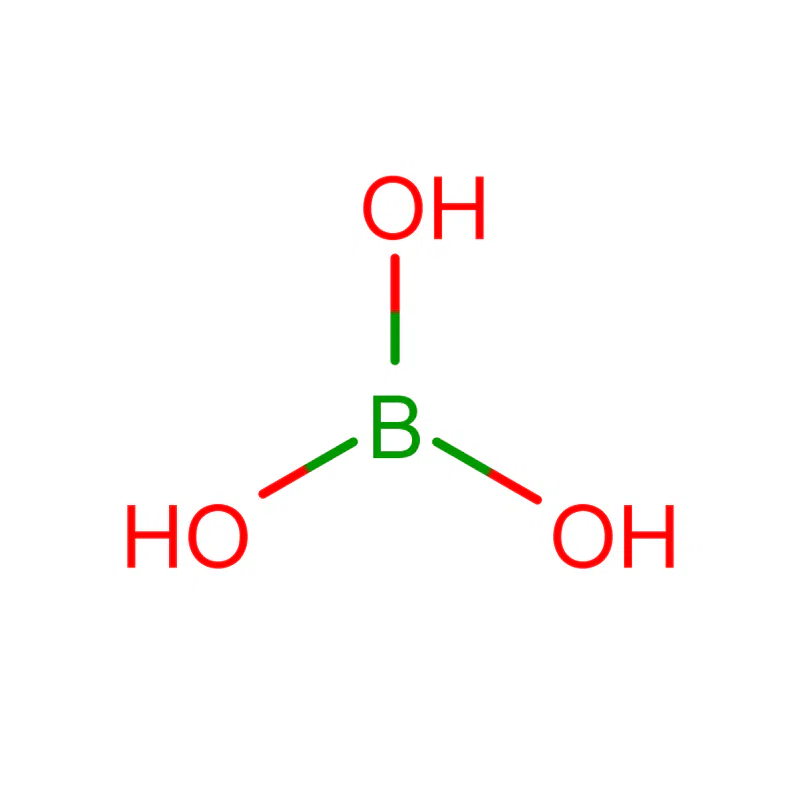
Products Description of Boric Acid CAS#10043-35-3
Boric acid, commonly referred to as orthoboric acid, is a typical weak monobasic inorganic acid generally prepared by the acidification reaction of natural borax raw materials. The compound features good solubility performance, being soluble in water, ethanol and glycerol solvents. Its aqueous solution presents weak acidity, with water solubility that increases significantly as temperature rises, endowing it with adjustable dissolution characteristics in different temperature environments.
Boric acid possesses distinct thermal decomposition properties under continuous heating conditions. When heated to 169°C (±1°C), it dehydrates and converts into metaboric acid. Further continuous heating up to nearly 300°C will trigger complete dehydration, forming boric anhydride. Chemically, it shows variable reaction characteristics under different alkaline environments. It reacts with strong alkali substances to generate metaborates, while forming tetraborate compounds in weak alkaline conditions, which enables it to participate in diverse synthetic reactions and adapt to a wide range of industrial chemical applications.
Boric Acid Chemical Properties
| Melting point | 169 °C |
| Boiling point | Decomposes before boiling (atmospheric pressure); 219-220 °C @9.75 mmHg |
| density | 1.437 g/cm³ (at 15 °C) |
| refractive index | n₂₀/D 1.330-1.340 |
| storage temp. | Room temperature; store sealed, dry, well-ventilated |
| solubility | Water: 4.72 g/100 mL (20 °C), 5.7 g/100 mL (25 °C); soluble in lower alcohols & glycerol; slightly soluble in acetone |
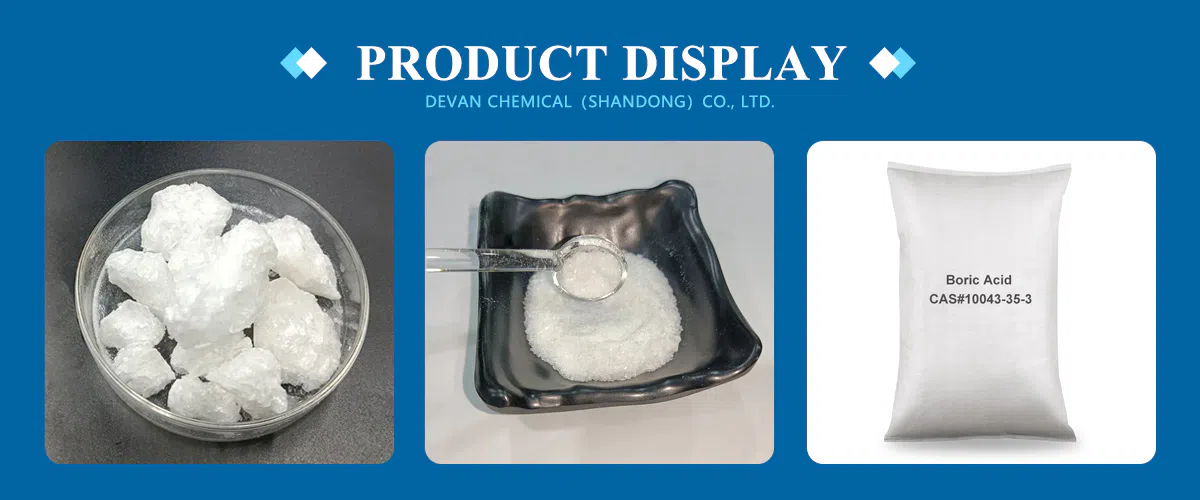
| form | Crystalline solid / shiny flakes or powder |
| pka | 9.24 (first, at 25 °C) |
| color | White |
| Water Solubility | 49.5 g/L (20 ℃) |
| BRN | 1697939 |
| InChI | InChI=1S/BH3O3/c2-1(3)4/h2-4H |
| InChIKey | KGBXLFKZBHKPEV-UHFFFAOYSA-N |
| SMILES | B(O)(O)O |
| CAS DataBase Reference | 10043-35-3 |
| Hazard Codes | T |
| Risk Statements | R60 |
| Safety Statements | S22-S36/37-S45 |
| RIDADR | NONH for all modes of transport |
| WGK Germany | 2 |
| HazardClass | Not classified for transport |
| HS Code | 2810002000 |
Product Application of Boric Acid CAS#10043-35-3
Boric acid serves as a fundamental raw material for the synthesis of various boron-containing chemical products, covering borate salts, water glass and borate esters, supporting the basic production demand of the fine chemical industry. It enjoys broad applicability across multiple manufacturing sectors, including optical glass processing, enamel crafting, coating and pigment production. It is also a common functional ingredient in cosmetics, food preservation, leather finishing, textile printing and dyeing auxiliaries, as well as pharmaceutical manufacturing industries.
Beyond industrial production, boric acid exhibits excellent antiseptic, disinfecting and astringent properties. These unique functional characteristics make it widely applicable in daily hygiene care and medical fields. It can be used for mild sterilization, skin care conditioning and routine sanitary treatment, occupying an important position in both industrial manufacturing and biomedical auxiliary applications.