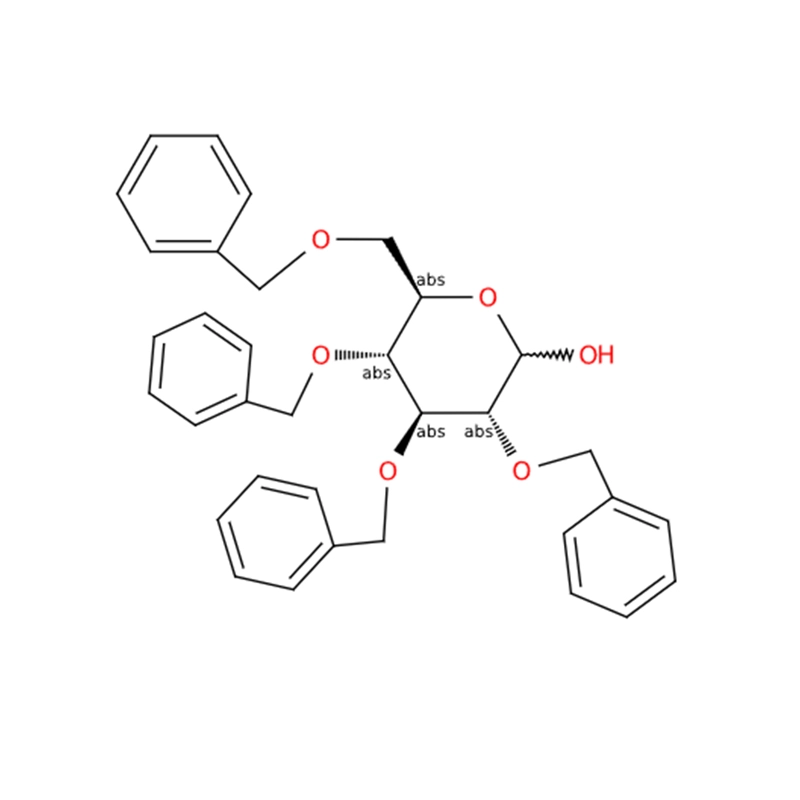
Product Description of 2,3,4,6-Tetra-O-benzyl-D-glucopyranose CAS#4132-28-9
2,3,4,6-Tetra-O-benzyl-D-glucopyranose is a fully benzyl-protected glucose derivative, with the molecular formula C₃₄H₃₆O₆ and a molecular weight of 540.65. This compound commonly occurs as a white or off-white crystalline solid at room temperature. All hydroxyl groups of the glucose ring are shielded by benzyl protecting groups, which effectively avoid undesired side-reactions during glycosylation and other synthetic transformations.
It is barely soluble in water and shows good solubility in chloroform, dichloromethane and other anhydrous organic solvents.The product is available with high purity, suitable for laboratory and pilot-scale oligosaccharide synthesis.

2,3,4,6-Tetra-O-benzyl-D-glucopyranose Chemical Properties
| Melting point | 145-149 °C(lit.) |
| Boiling point | 672.4±55.0 °C(Predicted) |
| density | 1.22±0.1 g/cm3(Predicted) |
| storage temp. | Sealed in dry,Store in freezer, under -20°C |
| solubility | Soluble in chloroform |
| pka | 11.87±0.70(Predicted) |
| form | Solid |
| color | White to Off-White |
| optical activity | [α]20/D +49±2°, c = 2% in dioxane |
| InChIKey | OGOMAWHSXRDAKZ-BKJHVTENSA-N |
| SMILES | OC1O[C@H](COCC2=CC=CC=C2)[C@@H](OCC2=CC=CC=C2)[C@H](OCC2=CC=CC=C2)[C@H]1OCC1=CC=CC=C1 |
| CAS DataBase Reference | 4132-28-9(CAS DataBase Reference) |
| Hazard Codes | Xi |
| Risk Statements | 36/37/38 |
| Safety Statements | 26-36-24/25 |
| WGK Germany | 3 |
| HS Code | 29400090 |
Product Application of 2,3,4,6-Tetra-O-benzyl-D-glucopyranose CAS#4132-28-9
2,3,4,6-Tetra-O-benzyl-D-glucopyranose is a fundamental glycosyl building-block for carbohydrate chemistry and pharmaceutical intermediate manufacturing. It supports the construction of diversified biologically-active sugar derivatives, including glycosylated compounds studied for Alzheimer’s disease, as well as sulfated, phosphorylated and indole-pyrrole-carbazole sugar skeletons with anti-tumor research value. This protected-glucose precursor is also involved in developing perfluoroalkyl sugar conjugates for cancer diagnosis and synthesizing glucose-based drug candidates targeting diabetes, such as voglibose and nojirimycin derivatives.
Besides, it can be converted into halogenated, 1-alkylated and other modified glucopyranose intermediates, and applied in polysaccharide, glycolipid and special crown-ether phase-transfer catalyst synthesis for multi-disciplinary biomedical research.